What is enamel craftsmanship? Differences between genuine and imitation enamel, a comprehensive analysis of the 6 major production processes and QC quality control.
Gain a comprehensive understanding of the definition of enamel (Hard Enamel / Cloisonné), the core differences between genuine enamel and imitation enamel and baking paint, the 6 major in-depth production processes, and the QC quality inspection standards at each stage, helping you quickly master the essence of the highest-grade coloring process.
What is enamel craftsmanship?
Enamel (Hard Enamel / Cloisonné) is a high-end decorative technique that involves filling colored enamel into metal grooves, firing it at high temperatures, and then grinding and polishing it until it is flush with the metal frame.
Core features:
- Surface finish: Smooth as a mirror, with a unique gem-like luster and noble texture.
- Durability: The color remains unchanged for a long time, and it is wear-resistant and corrosion-resistant.
- Positioning: Recognized as the highest-end, most demanding visual and quality expression in metal coloring processes.
Genuine Enamel vs. Imitation Enamel: A Comparison of Core Performance and Indicators
In customization and procurement, enamel craftsmanship is mainly divided into two categories: true hard enamel and imitation hard enamel. The two differ significantly in their technological principles, surface effects, and prices.

| Comparison Dimensions |
True Hard Enamel |
Imitation Hard Enamel |
| Process Principle |
Multiple high-temperature firing processes (800-900°C) + grinding and polishing until flush with the metal frame |
A single-layer baking paint followed by grinding and polishing results in a surface smoothness slightly inferior to genuine enamel, but at a lower cost. |
| Surface effect |
Completely smooth, flush with the metal frame, and has a mirror-like finish. |
The surface is nearly smooth and has a high gloss. |
| Durability |
Never fades, can be passed down for centuries |
Under normal use, it will not fade for 5-8 years. |
| Price positioning |
The highest grade, with a unit price 2-3 times that of ordinary painted finish. |
Mid-to-high-end, with a unit price 1.5–2 times that of ordinary painted products. |
| Delivery cycle |
It takes a relatively long time, generally 20–30 days. |
Shorter, generally 10–15 days |
| Representative application products |
Olympic medals, state gifts, high-end collectibles, watch dials/jewelry |
Mid-to-high-end gifts, medals and souvenirs, chamber of commerce badges, and high-end cultural and creative products. |
Deep processes in enamel craftsmanship (6 key steps)
The complete production of enamel products involves six precise and interconnected processes:
Embryo preparation------------Filled enamel------------Millstone------------Grinding and polishing------------Electroplating------------Inspection packaging
Step 1: Blank Making (Die Casting/Stamping): The metal blank is made according to the drawings, usually using high-quality copper. It is crucial to ensure the blank is free of pores and sand holes, guaranteeing a flat and sturdy base.Step 2: Enameling Filling (Core Step): Finely selected enamel powder is manually mixed according to color and precisely filled into the metal grooves.Step 3: Grinding (Removing Excess Paint/Glaze): After enamel application and firing, excess paint/glaze is removed using a professional grinding stone to smooth the surface before further processing.Step 4: Grinding and Polishing (Critical Step): After natural cooling, the surface is finely ground with a grinding stone until the enamel is completely flush with the metal edges. Repeated grinding and polishing create a bright, mirror-like finish.Step 5: Electroplating (Surface Finishing): Gold, nickel, or bronze plating processes are used to enhance the luster and durability of the metal lines (the enamel areas require protection during this process).Step 6: Inspection and Packaging (Quality Control): Inspect the flatness and surface defects of the enamel surface, check the electroplating color and gloss, and finally carry out moisture-proof and shockproof packaging.
The difference between enamel and baking paint
The key to determining whether a process is enamel or baking varnish lies in the different sequence of steps:
- Enameling process: First, apply color/glaze → Polish with a grinding stone → Then, electroplating.
- Baking paint process: First electroplating ➔ then applying color and baking paint
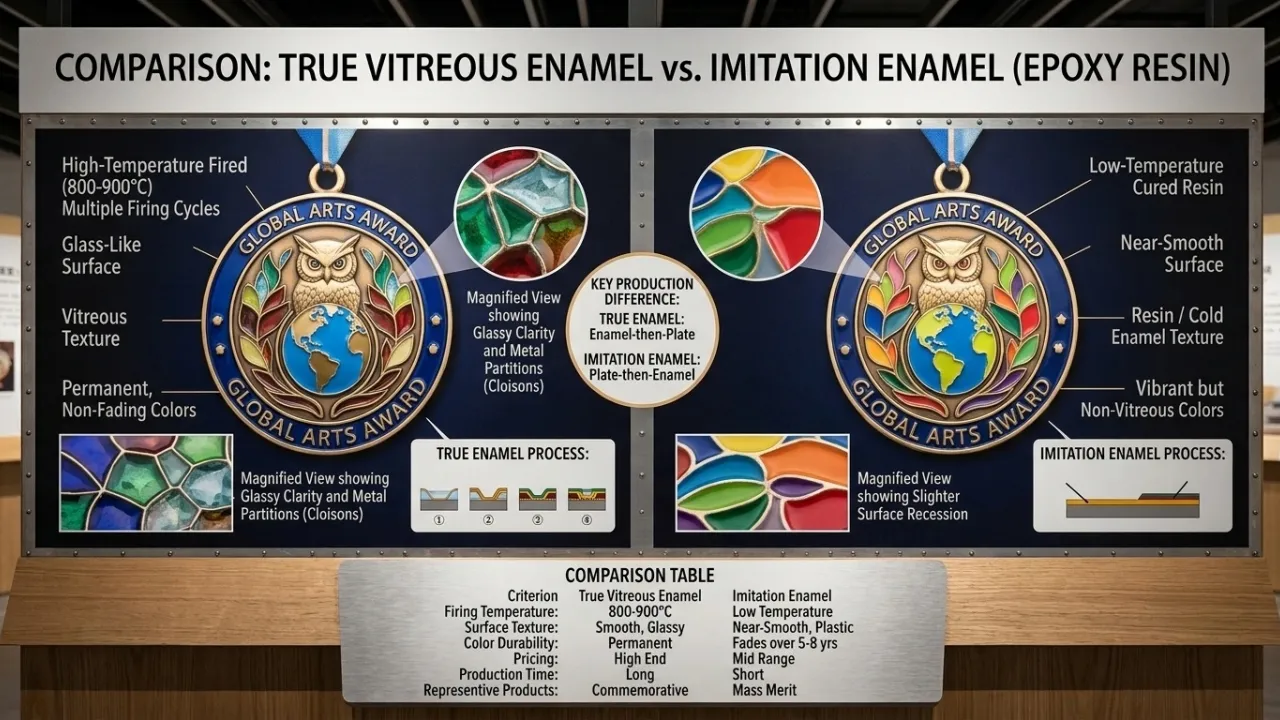 With its superior texture and centuries-old durability, enamelware holds an irreplaceable position in high-end gifts and jewelry. Understanding the differences between genuine and imitation enamel, mastering the manufacturing sequence of "coloring before electroplating," and strictly controlling six QC inspection points are fundamental guarantees for the manufacture and customization of exquisite enamel pieces.


